
IFM Project Screening is here – plus key ARR updates you may have missed
Over the past few months, we’ve been expanding the NbS Project Screening tool to support more forest carbon use cases and reduce friction in early-stage project evaluation.
The latest release introduces IFM screening, alongside several important ARR updates designed to improve consistency and speed across the project screening process.
If you haven’t checked in recently, here’s what’s new.
New: IFM module for project screening
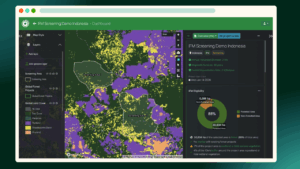
You can now screen potential Improved Forest Management projects directly in the NbS Project Screening Tool.
The new IFM module allows users to assess whether the project area is eligible under Verra’s VM0010 methodology (i.e., the area must be classified as forest), based on present day land cover data, supplied by our screening-grade Global Harmonised Layers dataset.
You can adjust a few parameters to make sure the assessment reflects real-world conditions:
Forest regrowth duration
- The time taken (in years) for forest biomass to return to pre-harvesting level via natural regrowth.
- The default value is set to 40 years, based on typical scenarios.
- The user can adjust the value between 30 and 100 years.
Forest sequestration rate
- The annual mean carbon sequestration (tC/ha/year) due to forest growth under the project scenario. This represents the carbon accumulation in above-ground biomass when forests are managed sustainably without harvesting.
- The default value is 2 tC/ha/year, based on typical scenarios.
- The user can adjust the value between 0 and 5 tC/ha/year.
The predicted emissions avoidance and removals in tCO2e takes into account standing biomass within the project area, baseline harvest rotations, forest regrowth rates and emissions incurred due to harvesting activity. We assume no leakage or disturbances over the project period and ignore carbon emissions attributed to harvesting 3+ years after harvest.
The goal is early clarity: quickly understanding whether a potential IFM project meets basic methodological and performance expectations before moving into deeper due diligence.
With this release, the tool now supports ARR, REDD+, and IFM, making it easier to evaluate and compare projects across the main forest carbon approaches using a single dataset and carbon expertise.
ARR update: automatic performance benchmark discount
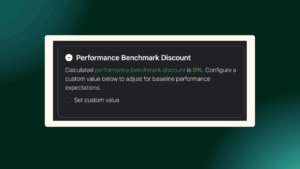
The performance benchmark is part of VM0047’s dynamic baseline and represents how much of the project’s performance is estimated to have happened without intervention. It is then used to calculate the discount (difference in the performance between the project and control areas) to adjust the reported removals.
The Screening tool now automatically suggests the most appropriate performance benchmark discount for your project, using timeseries remote sensing of biomass changes in your selected area. The value is calculated by comparing the expected growth under the project scenario (based on the growth curve) with the expected growth in the absence of a project.
This lets you model different planting scenarios and get the most accurate view of your project’s carbon potential.
ARR update: automatic growth curve calculation
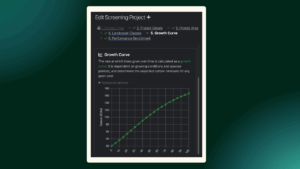
The growth rates of ARR projects are a key input to a project’s returns – and especially critical in the first 5-year crediting period. But finding appropriate species data and local growth information to turn into trustworthy projections is often time consuming and complex.
Without a localised approach, early-stage project forecasting turns into guesswork.
The NbS Screening tool for ARR now handles this for you.
The tool automatically selects an appropriate growth rate for your project area based on academic literature (Robinson et al. 2025). And if you have your own carbon saturation data, you can override it.
This means you can:
- Screen ARR projects faster
- Get more realistic carbon removal estimates
- Make informed decisions without waiting for weeks of specialist input
This makes it easier to scale ARR screening without rebuilding growth models for every project.
See the updates in action
To walk through the new IFM module, explain the ARR updates, and answer common questions, we’re hosting a live webinar focused on real screening use cases.
The session will be led by Dr Alexis Moyer and Dr Sophie-Flack-Prain and will cover:
- IFM screening under VM0010
- ARR performance benchmark discount and growth curves
- How these features address common pre-issuance screening challenges
- Live Q&A
Whether you already use the tool or are catching up on recent updates, this is a practical overview of what’s new and how it can support your screening process.