
Introducing NbS Project Screening Pro: permanence risk analysis for pre-issuance ARR projects
A pre-issuance project can look strong on paper and still fail to deliver. The question that decides an ARR investment is not only whether a project is eligible today — it is whether the credits you contract will still be standing in 20 or 30 years, and whether the project even reaches validation. Answering that has meant weeks of specialist work and datasets stitched together by hand.
That is the question NbS Project Screening Pro is built to answer. NbS project Screening Pro — the expanded version of our Screening tool that powers the Symbiosis RFP process — is now available for general access, with 3 new modules: Baseline, Leakage Risk and Durability Risk.
When you have found a pre-issuance project you want, you need to understand its risks (and how the developer plans to mitigate them) before you move capital. Screening Pro is a self-serve, automated tool that sits between basic eligibility screening and full due diligence, giving carbon teams a faster way to shortlist NbS projects and focus attention where it matters most.
Why a rating isn’t enough for ARR projects
A project rating only goes so far. For ARR projects, you need to dig into the numbers — to assess not just project eligibility and carbon potential, but whether those credits could actually be delivered, and whether there is a risk of activity displacement. Many pre-issuance projects are not yet covered by ratings agencies, and collating datasets and working through the literature to answer these questions for every candidate is slow and repetitive.
Building this analysis in-house needs GIS expertise. More advanced portfolios have geospatial teams, but they are often stretched thin under pressure to screen and deliver a strong set of projects to invest in. Then there is the tooling. Screening becomes a build-your-own exercise — stitching together multiple non-specific tools and datasets, alongside deep knowledge of a long list of methodologies. The result is often a slow, clunky and expensive workflow that stalls investment in the projects that could make a difference.
That is why we built Screening Pro. It brings these elements together in one automated workflow, with consistent data and our best expertise of carbon methodologies.
What Screening Pro assesses
Screening Pro runs an automated review on the project’s boundary and returns results in minutes. Its modules cover:
- Baseline — an ex-ante baseline discount for the project area.
- Growth curve — the developer’s curve compared against species- and region-specific reference data.
- Leakage risk — displacement pressure around the project.
- Durability (permanence) risk — future exposure to climate, fire and human pressure.
- Carbon potential and crediting — an estimate of potential carbon sequestration based on our expertise and global screening data.
That makes it useful for NbS project investors, off-takers and carbon teams that need to filter many candidates before committing to a fuller due-diligence review of social benefits and operational risks.
How the baseline module works
The baseline module computes an ex-ante baseline discount for the project area. It gives an early view of whether the area shows high natural regrowth — and therefore attracts a heavier baseline discount.
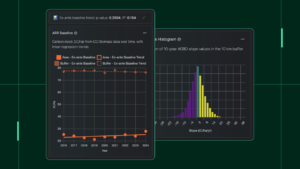
The baseline screen uses land-cover classification of the proposed planting area, historical biomass trends over a 10-year reference period, and CCI Biomass data as the proxy stocking index. The output is a slope value for each pixel and a histogram of the slope distribution across the area.
For operating projects, the module also supports performance comparison against a forecast baseline, including stocking-index trends and control-area comparisons.
Why growth-curve comparison matters
Tree growth drives carbon crediting. If a developer’s growth curve looks too optimistic, the crediting forecast can climb above what the area is likely to support.
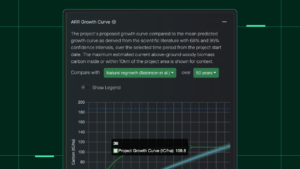
Screening Pro compares the developer’s curve against calibrated reference datasets for that location. For species-based planting plans, it draws on a curated growth-curve database built from the literature. For native-species mixes, it uses Robinson et al. geospatial data to parameterise a curve that reflects secondary forest growth for that location.
Permanence is delivery risk
Permanence sits at the heart of delivery risk. Will the credits you contract today actually be delivered in 3, 5 or 10 years — and will the project reach validation in the first place?
Reversals driven by climate change can erode a portfolio’s integrity. Credits from a project that loses decades of stored biomass to an extreme fire after 15 years carry real risk — and it may fall to you to defend that to your board, or publicly, later on.
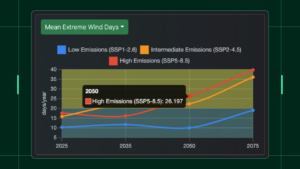
So the tool assesses durability: a project’s future vulnerability as the climate changes. We look at temperature extremes, extreme wind, flooding, sea-level rise, fire history and human deforestation pressure, out to 2075.
Conditions are assessed as they stand today, but suitability and survivability can shift as the climate changes. These are exactly the questions early-stage diligence should surface, so investors and off-takers can press developers on their mitigation plans before signing.
Two projects, two risk profiles
The clearest way to show what Screening Pro surfaces is to run it on proposed projects. Below are two shortlisted pre-issuance ARR projects — one in Indonesia, one in Brazil — reviewed against their PDDs.
Case study: community-led restoration in Kalimantan, Indonesia
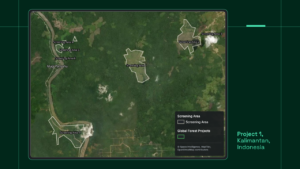
This project focuses on community-led native woodland restoration in Kalimantan, aiming to restore degraded ecosystems and promote sustainable land management.
Baseline. The tool forecasts a baseline discount of 0, matching the developer’s estimate.
Growth curve. The developer’s curve looks reasonable. It shows a higher initial growth rate, but total removals over the project lifespan stay close to the tool’s independent estimate.
Leakage. The module returns a moderate risk level. It quantifies forest-to-agriculture conversion across a 10 km buffer around the project area and assigns a low, medium or high status to the conversion pressure. High pressure does not mean high leakage, but it does mean the developer needs a credible mitigation plan. Here, the surrounding area shows pockets of historical forest-to-agriculture conversion with a slight increase over time, leaning heavily toward grassland — which likely reflects pasture activity in the region.
Durability. The module assesses future forest vulnerability to climate change up to 2075: temperature extremes, extreme wind, flooding, sea-level rise, fire history and human deforestation pressure. Most factors sit at negligible levels, and temperature and flooding stay within normal ranges. Extreme wind is the exception. The tool shows a strong increase in high-wind-speed days under intermediate and high emission scenarios — which matters because high winds cause windthrow, damaging young trees before they mature. The developer addresses this by selecting wind-tolerant species for the planting mix.
Carbon potential. The PDD’s crediting estimate sits within 10% of the tool’s estimate, so the tool raises no concern here.
Case study: eucalyptus planting in Brazil
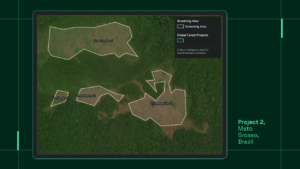
This project converts extensive cattle-ranching land into productive forest landscape, planting and managing eucalyptus alongside other restoration activities.
Growth curve. Because the species is known, the tool uses a pre-loaded eucalyptus growth curve for South America. The developer’s curve sits higher than expected. That does not prove it wrong, but it does call for additional evidence: the difference reaches nearly 100 tonnes of carbon per hectare across total removals over the project lifespan.
Leakage. The module again returns a moderate risk level. The wider area shows higher conversion pressure along the frontier, much of it to grassland — reflecting cattle-ranching pressure in the region. The conversion rate looks relatively consistent over time.
Durability. Fire is the main concern. The project area shows no fire in the last 5 years, but the wider area carries fire pressure. Fire is a permanent threat for forest projects because it can release decades of stored carbon in a single season if it is not properly managed. The PDD does not mention fire. In this case, the developer needs to revise the plan and add suitable mitigation measures.
What the comparison shows
Two very different risk profiles, surfaced in minutes:
- Indonesia: strong baseline alignment, a reasonable growth curve, moderate leakage risk, and a wind-related durability risk that the developer addresses.
- Brazil: an unusually high growth curve, moderate leakage risk with cattle-ranching pressure nearby, and a fire risk the PDD does not address.
That combination tells a carbon team exactly where to focus follow-up questions before doing any deeper diligence.
See it on your own project
The fastest way to understand Screening Pro is to watch it run on a project you already know. Bring a pre-issuance ARR project you are weighing up, and we will show you its baseline, growth curve, leakage and durability risk — in minutes.
Your first run on a new project is free. Talk to our team to get started.